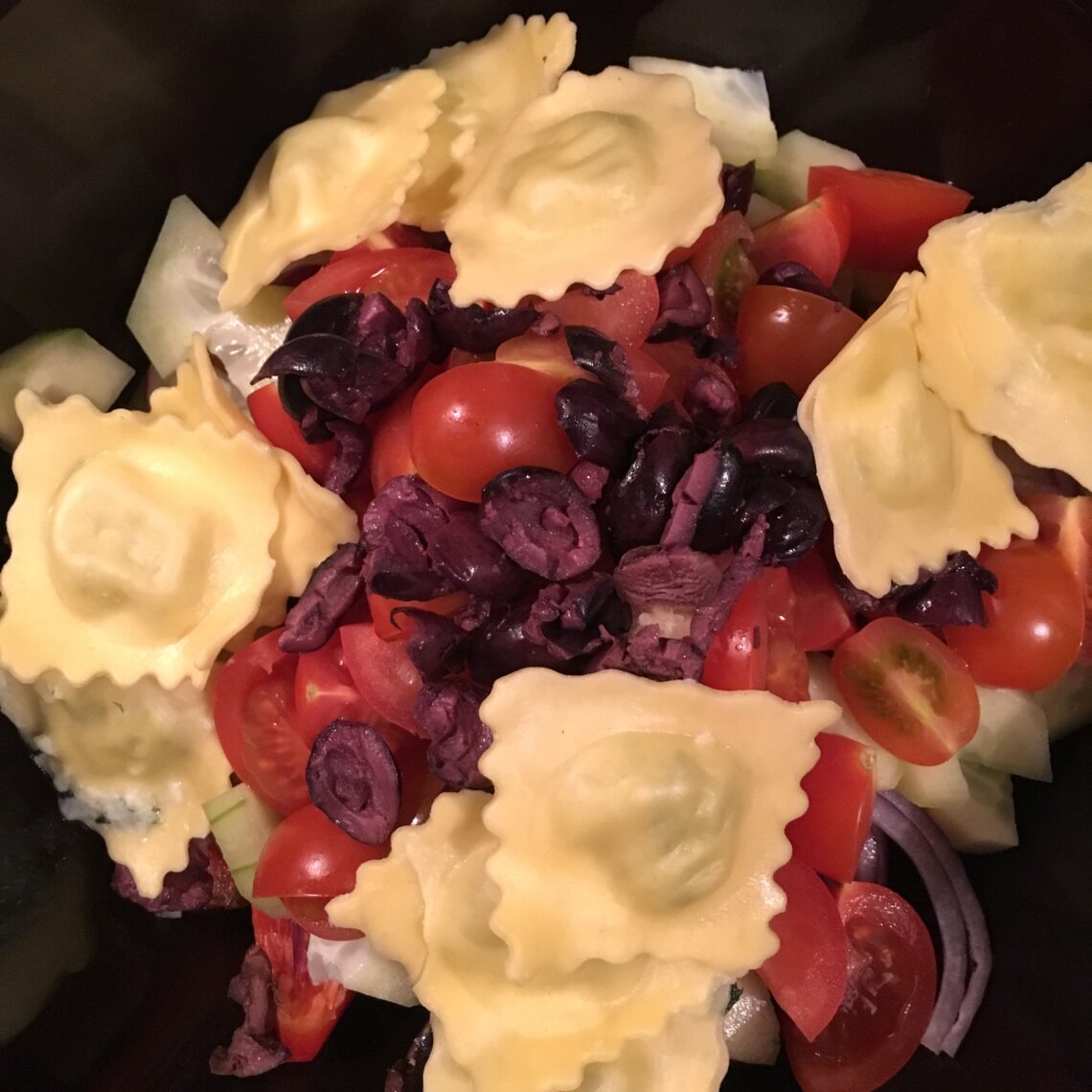
Vegan Tortellini Salad
Please test each unfamiliar ingredient carefully according to your dietary restrictions, even if it is labeled as suitable for your diet. Every body is different, and what I tolerate may cause reactions in you. So always listen to your body!
Before we begin, please take a moment to read the overview of the dietary restrictions for this dish. You’ll find them below the recipe.
| Serves: 4-6 Portions Time: 20-25 minutes Ingredients: 1 package of vegan tortellini (or any other type of pasta or rice) 1 small to medium red onion (or spring onion for a histamine-free version) 1 garlic clove 2 tomatoes (or bell peppers for a histamine-free alternative) 1 cucumber 2 tsp dried oregano 3 tbsp soy sauce (or histamine-free version, see Tips & Tricks) 2 tbsp balsamic vinegar (or histamine-free version, see Tips & Tricks) 2-3 tbsp olive oil Olives optional Instructions: Cook the tortellini: Follow the package instructions to cook the tortellini. Once cooked, drain and set aside to cool. Prepare the vegetables: Slice the red onion into thin half-rings, and cut the tomatoes (or bell peppers) and cucumber into cubes. Add them to a large bowl with the cooled tortellini. Make the dressing: In a small bowl, whisk together the soy sauce, balsamic vinegar, olive oil, and oregano. Pour the dressing over the salad and toss everything to combine. Serve and enjoy! Tip: If you prefer a milder flavor, reduce the amount of soy sauce and balsamic vinegar to suit your taste. Estimated Nutritional Values per Serving (for 4 servings): Calories: approx. 300-350 kcal Protein: approx. 8-10 g Fat: approx. 14-16 gSaturated fat: approx. 2-3 g Carbohydrates: approx. 35-40 gSugars: approx. 5-7 g Fiber: approx. 4-6 g Sodium (Salt): approx. 600-800 mg (depending on the amount of soy sauce and salt) |
This recipe is quite versatile and can be adapted for several dietary restrictions. Here’s a breakdown of the main dietary categories for which it is suitable:
Vegan
- The recipe is vegan-friendly since it uses vegan tortellini and plant-based ingredients like olive oil and soy sauce.
Gluten-Free (with modifications)
- The recipe can be gluten-free if you use gluten-free tortellini. Most store-bought tortellini contain gluten, so make sure to use a gluten-free version if you’re following a gluten-free diet.
Vegetarian
- The recipe is vegetarian-friendly, as it does not contain any meat or animal-derived products, aside from the option to use dairy-based tortellini.
Dairy-Free
- This recipe is dairy-free, especially if you use plant-based tortellini and ensure that the soy sauce is also dairy-free.
Low FODMAP (with modifications)
- This recipe can be adapted for a Low FODMAP diet with a few substitutions. For example:
- Use spring onion instead of red onion (since red onion is high in FODMAPs).
- Swap tomatoes for bell peppers (which are lower in FODMAPs).
- By making these adjustments, the recipe can be better suited for individuals with IBS or those on a Low FODMAP diet.
Histamine-Free (with modifications)
- For people who need to follow a histamine-free diet, you can modify the recipe as follows:
- Use histamine-free soy sauce or tamari (ensure it’s free of added preservatives) as recommended in Tips & Tricks.
- Replace balsamic vinegar with a histamine-free alternative as reccomended in Tips & Tricks.
- Swap tomatoes for bell peppers (which are lower in histamines).
- Use spring onion instead of red onion, as it’s typically less problematic for those sensitive to histamine.
Nut-Free
- The recipe is nut-free, as it doesn’t contain any nuts or nut-based ingredients.
Soy-Free (with substitution)
- If you have a soy allergy, you can replace the soy sauce with a soy-free alternative, like coconut aminos or another soy-free seasoning sauce.
Low Fat (optional)
- You can make this recipe lower in fat by reducing the amount of olive oil or using a low-fat alternative.
Diabetic-Friendly (in moderation)
- The recipe can be suitable for diabetics, as it contains complex carbohydrates from the tortellini and vegetables. However, portion control is important due to the carbohydrates, especially if you’re using regular tortellini (which might contain refined flour). You can use whole wheat or gluten-free tortellini for a healthier option with more fiber.
Not Suitable For:
- People with a gluten intolerance or celiac disease (unless you use gluten-free tortellini).
- People with a soy allergy (unless you substitute the soy sauce with a soy-free alternative).
- People with a tomato allergy or sensitivity (unless you use bell peppers instead).

You want to be notified when ever I upload a new recipe? Follow me on Instagram

